



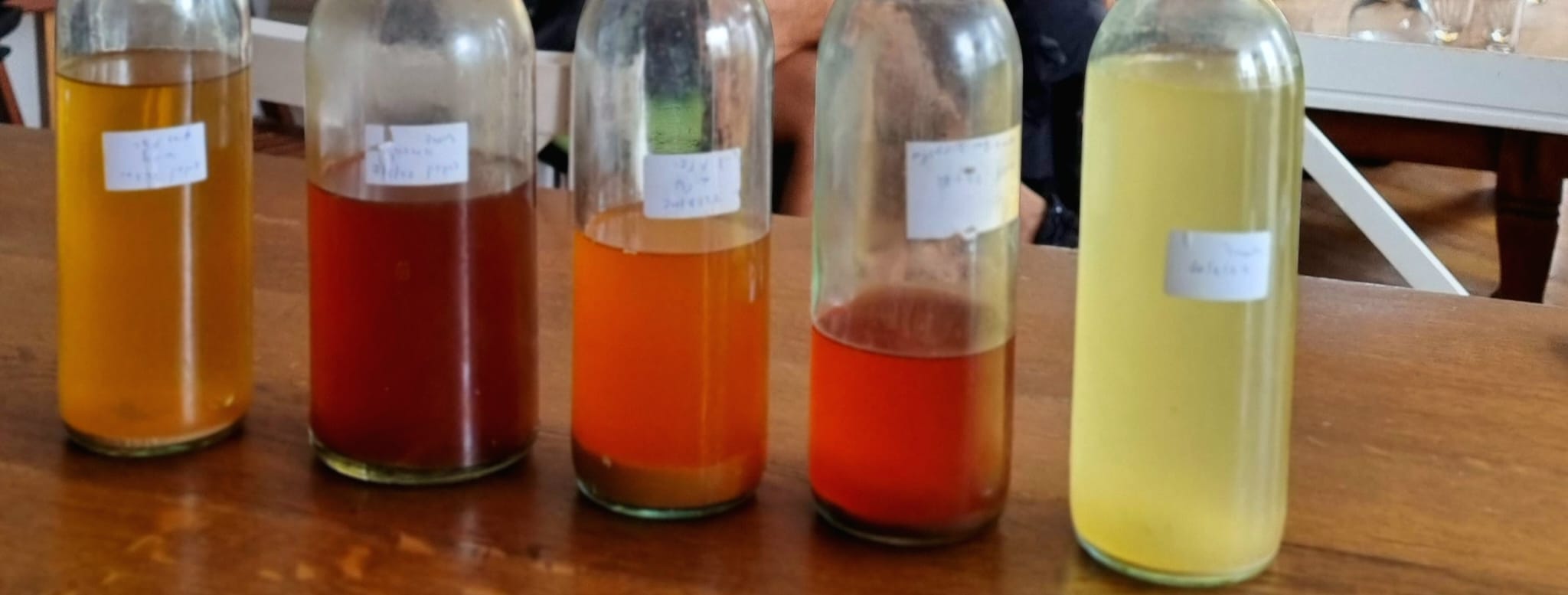
The honey used to make mead must be natural and unheated.
Ingredients:
-
Natural honey
-
Water
Instructions:
- In a large, wide-mouthed jar, mix honey and water. The usual ratio is one part honey to four parts water, but you can reduce the amount of honey to as little as one part honey for fifteen parts water.
- Place the jar with the mixture on the counter, cover it with a breathable cloth to keep fruit flies out, and stir well once or twice a day for ten days.
- After about ten days, you will have young, living mead. It will be very sweet, almost alcohol-free, but it will already have gone through its first fermentation and developed light fermented flavors.
- At this stage, pour the mead into a bottle. Place a balloon over the bottle’s opening. This prevents fresh oxygen from entering but allows the gases produced inside to escape.
- Leave the balloon on the bottle for about a month, or until it stops inflating, which means that the main fermentation has ended. Then cork the bottle and store it in the refrigerator.
- Another option, slightly more complex, is to seal the bottle with a cork instead of a balloon. Open it once a day to release the gases. The advantage of this method is that the pressure from the cork creates a lightly carbonated drink. The disadvantage is that if you forget to release the gases daily, the pressure may cause the bottle to explode.
The longer the mead sits in the refrigerator, the lower its sugar level will become, and the higher its alcohol content will rise.
Notes
You can add different spices during fermentation to enrich the flavor, from ginger to zuta levana. If you use fresh herbs, it is best to strain them out before bottling.
Recently, we have also begun making date-water mead.
-
Pit the dates.
-
Transfer the pitted dates into a pot.
-
Add enough water to cover the dates by about one centimeter.
-
Bring to a boil.
-
After the liquid cools, strain it.
-
Pour the strained liquid into a wide-mouthed jar and prepare date-water mead in the same way as honey mead, starting from step 2 in the honey mead recipe above.